slab bench
overview
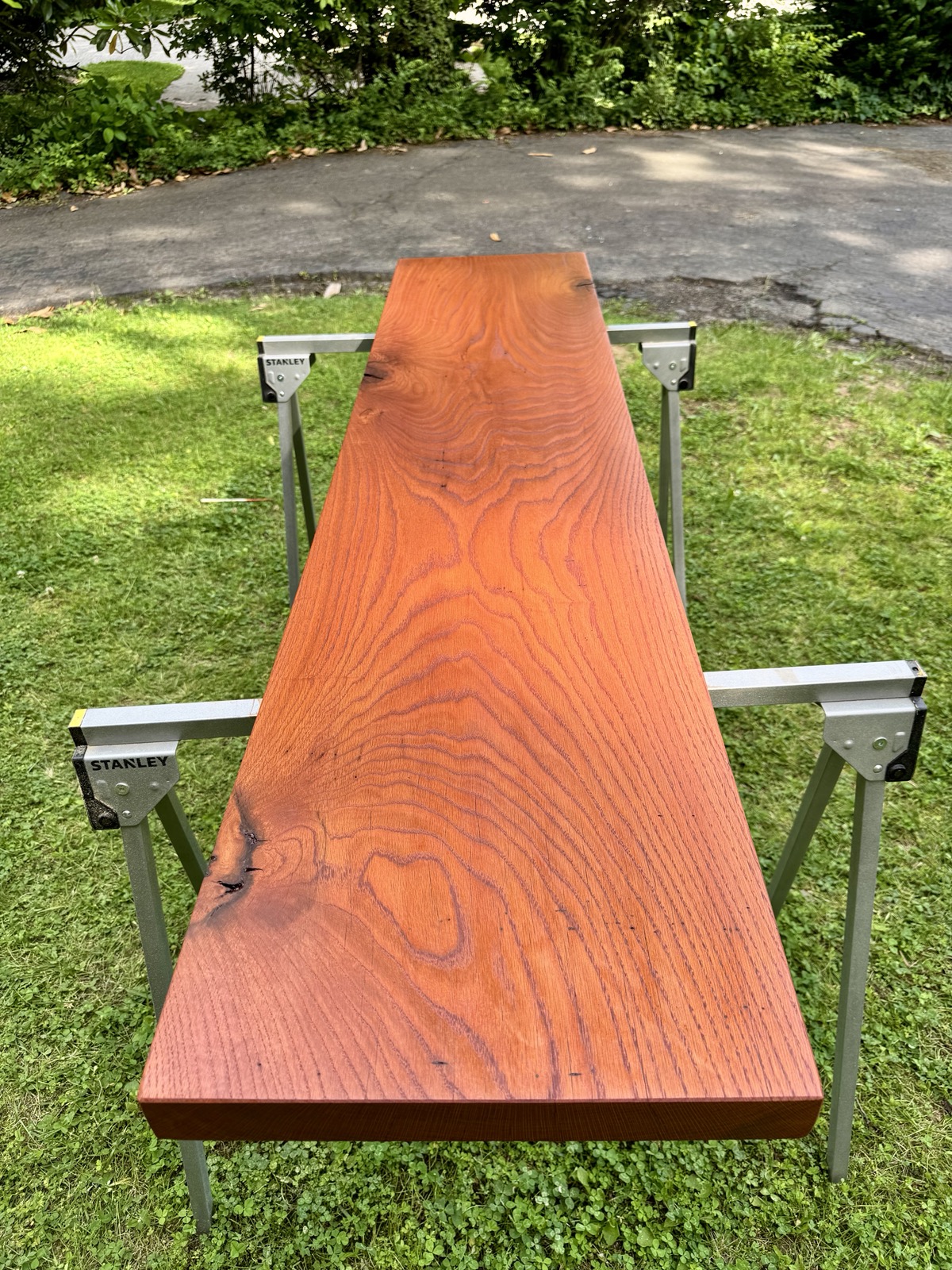
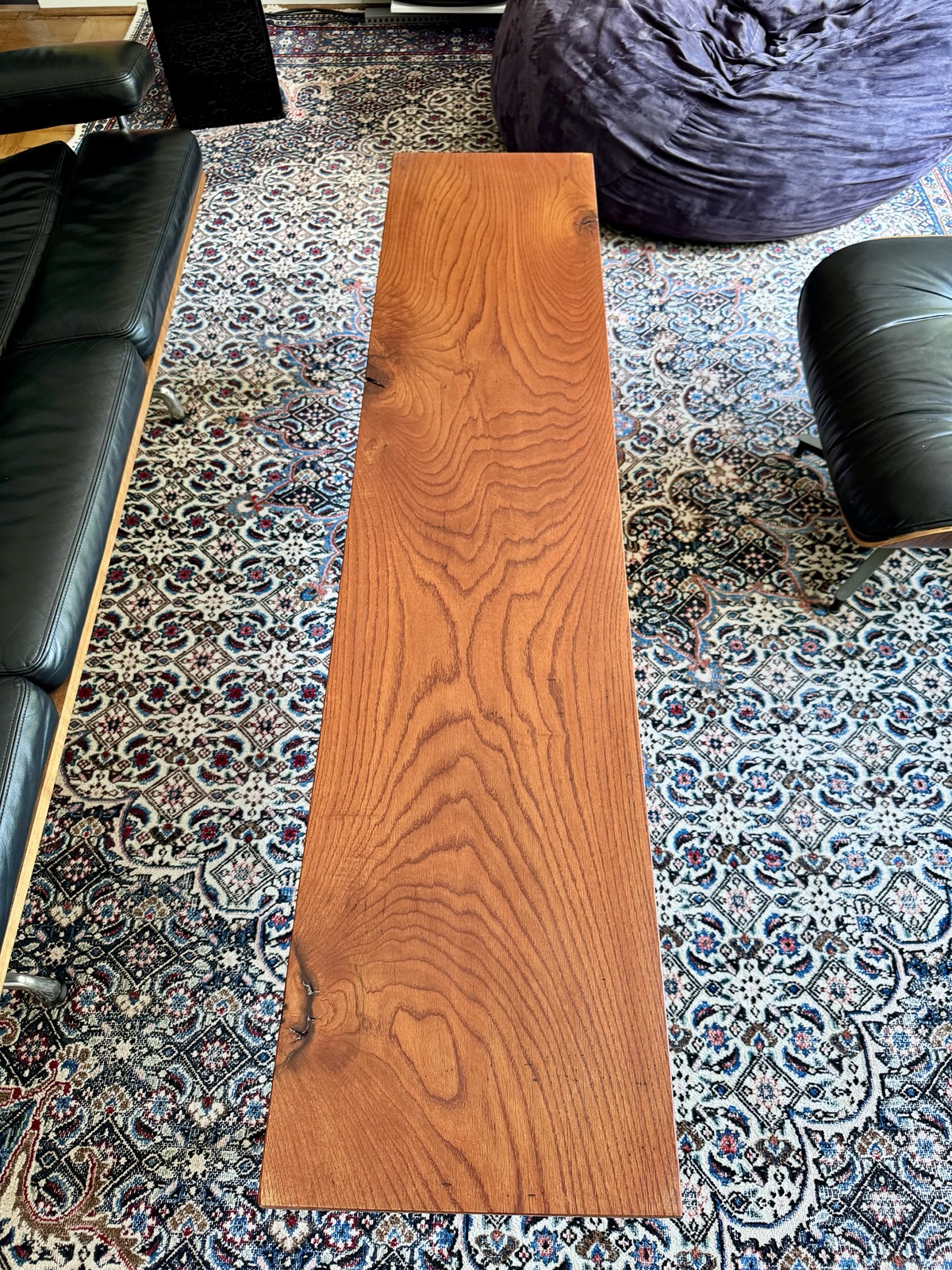
I’m making a bench from one of the white oak slabs I chainsaw-milled and later kiln-dried. The slab finishing, base design, and fabrication are captured here.
Note that my work environment is primitive, so don’t judge my finishing techniques too harshly. I basically picked a good string of days and set up a couple sawhorses in the carport. It’s not a clean room.
slab dimensions
| dimension | value |
|---|---|
| thickness | 48 mm |
| length | 1720 mm |
| width | 388 mm |
| total finished surface (both faces + all edges) | ~17 ft² (~1.55 m²) |
finishing
The plan was Rubio Monocoat Oil Plus 2C in Dark Oak. I switched to Real Milk Paint Dark Half because Rubio is fussy about temperature and humidity during application and the 5-day cure, and my carport is fussy about nothing. Unsatisfied with the tung oil finish, I sanded everything off and pivoted again.
sanding
Random-orbital sander with hook-and-loop discs. Through 150 grit on both faces, both end grains, and all four edges.
- 80 grit to knock down planer marks and any cup, until it read flat against a straightedge.
- 100 grit to remove the 80-grit scratch pattern.
- 120 grit to refine.
- 150 grit.
Between grits, I vacuumed the slab and the floor and wiped with a dry rag. I checked each step under a raking light at the edge of the slab and re-sanded any swirls or remaining mill marks before stepping up.
first coat (flood)
- Vacuumed sanding dust off everything. Wiped with a clean dry rag.
- Flooded the surface with Dark Half from the can, using a foam brush. Generous, kept it wet without puddling. End grain pulled it in fast and got more.
- Waited 40 minutes.
- Wiped the excess off with a clean cotton rag in firm passes, until the surface read uniformly oiled but not wet.
- Let it sit four hours.
the mistake
I sanded the slab to 220 grit between the first coat and the next, and kept sanding between the coats after that. This is wrong. Real Milk Paint says so directly - don’t sand between coats of tung oil. Partially-cured oil doesn’t abrade like a film finish. It gums up, smears across the surface, loads the disc, and turns into a hazy slurry of oil and sawdust that obscures the grain underneath.
I kept going anyway. Second coat with 220 grit beforehand, then 400, then 600. By the end the slab looked like it had been wiped with mud. Pigment streaks, no grain definition, a soft uneven film instead of the deep clear figure I’d built up.
the recovery
Citrus solvent dissolves uncured and partly-cured tung oil. It’s also the thinner inside Dark Half itself, so I knew it was compatible with whatever was on the slab. I doused the surface with straight citrus solvent (d-limonene degreaser) and worked it with cotton rags until the goop lifted off. It took a lot of rubbing, and I had to keep at it before the surface layers fully cured - once tung oil is hard, citrus solvent doesn’t lift it cleanly anymore.
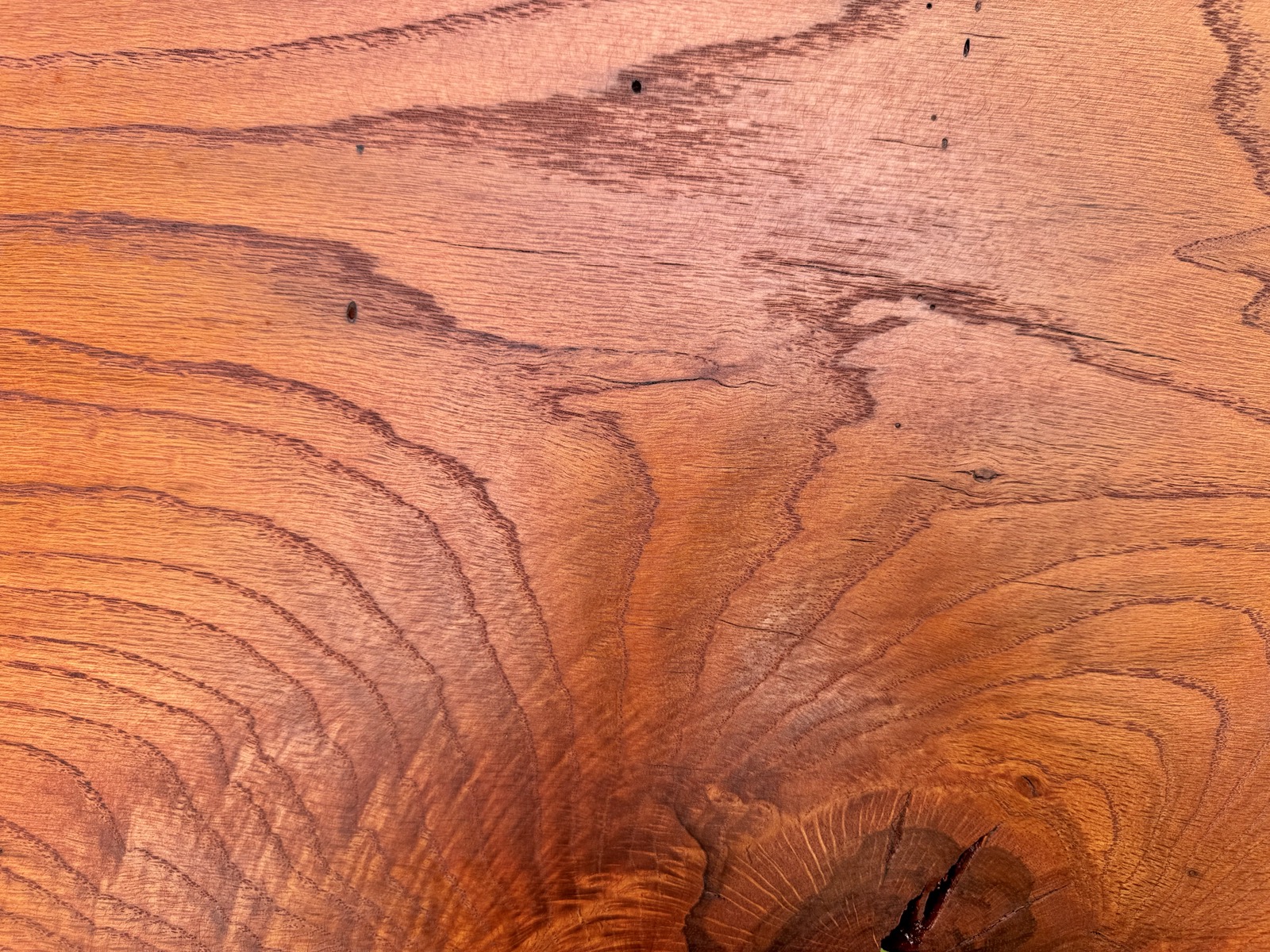
The deep tung oil from the first coat survived. It had penetrated into the grain and cured down there well before the surface mess started up top. End state: the slab is back to bare-feeling wood, sanded to 150 grit, with Dark Half permanently saturating the fibers below. The grain reads clean, the pigment that absorbed into the open pores is still in place, and the slab is darker than raw white oak with no streaky topcoat.
rebuilding the finish
I rebuilt the finish properly. Real Milk Paint’s directions for their thinned tung oil products call for 3 to 5 thin wipe-on coats for everyday-use furniture, no abrasion between coats. The wood was already saturated below the surface from the original first coat, so the later coats absorbed less and built surface sheen more than they would have on raw wood.
After the strip, I let the slab sit overnight in the carport so any residual citrus solvent could flash off. I did not sand again before recoating. The strip left the surface in a good state, and the pigment that absorbed into the open pores of the wood was sitting just below the surface - sanding at that point would have scrubbed off some of that pigment and lightened the slab unevenly. Raised grain from the solvent wipe-down laid back down under the next coat’s penetrate-and-wipe pass on its own.
Then, for each coat:
- Apply Dark Half thin with a lint-free cotton rag (an old undershirt works), not a foam brush. Just enough to wet the surface evenly, no flood.
- Let it soak 15 to 30 minutes.
- Wipe all excess off with a clean dry cotton rag. The surface should feel dry to the touch when you’re done, not tacky.
- Wait 24 hours before the next coat. Real Milk Paint allows as little as 2 to 3 hours between coats of their solvent-thinned blends, but overnight is safer and there’s no rush.
- Repeat until you’ve built three more coats on top of the existing first-coat penetration.
No sanding between coats. Not orbital, not by hand, not steel wool. If a coat dries with a nib or a speck, dampen a rag with a little Dark Half on the next pass and the irregularity dissolves back into the new coat.
After the final coat the slab cured for 30 days. Tung oil is touchable in a day or two but doesn’t reach full hardness for about a month. Once it was cured I put a paste wax topcoat over it - Real Milk Paint’s Soft Wax is the matched pairing, and any beeswax-and-carnauba furniture wax (Liberon Black Bison, Briwax) does the same job. Wax on cured tung oil gives a smooth hand-feel, adds abrasion protection for a surface that gets sat on, and brings the satin sheen up a touch without going glossy. It’s sacrificial and needs a refresh every couple of years.
oily rag disposal
Tung oil rags will spontaneously combust. They cure by oxidation, oxidation produces heat, heat speeds the oxidation, you get a runaway in a few hours and a fire in the rag pile.
Everyone seems to have various disposal methods involving the trash, but this seems cumbersome, and I put them in the fire pit and burn them.
base
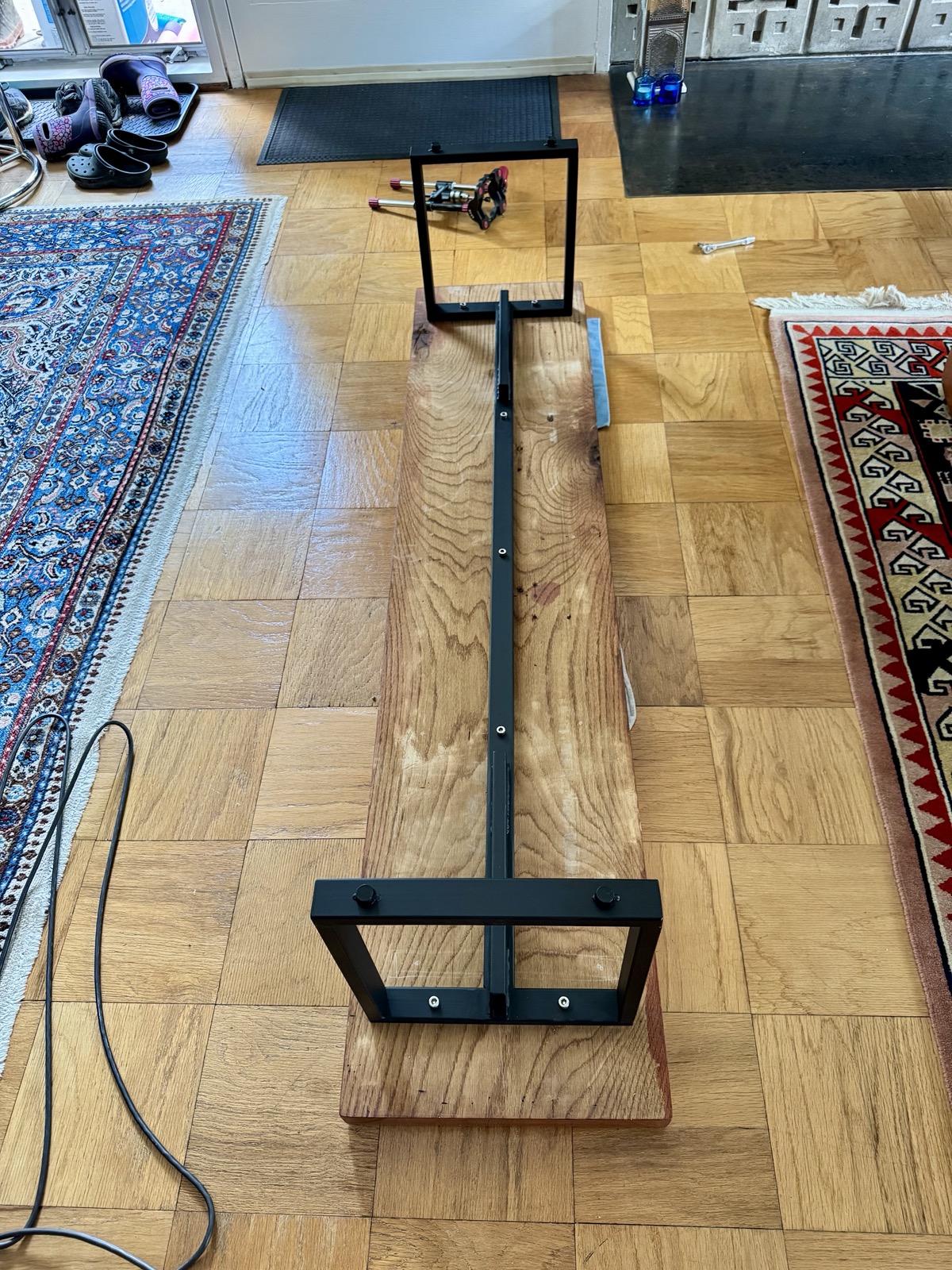
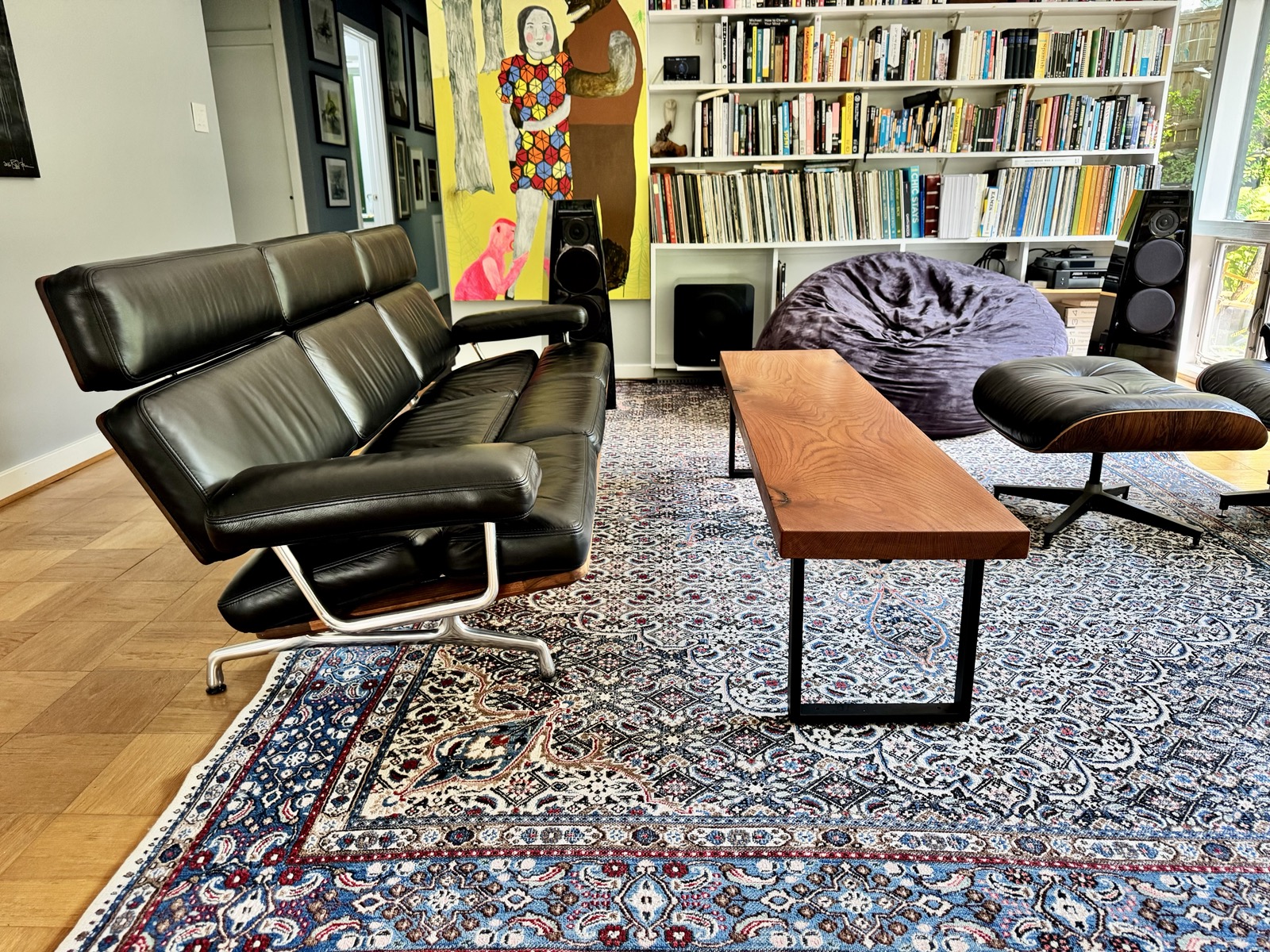
The base is two rectangular end frames joined by a single spine that runs the length of the bench along the underside of the slab, all of it built from rectangular tube steel, 1.5“ x 0.75“, 0.125“ wall, and finished black.
I designed this as splayed trapezoidal ends with a low stretcher down at the floor, and built it square instead. Vertical legs, and the connecting member moved up under the slab where it also does the work of carrying the fasteners. The wider footprint of a splay buys side-to-side stability that a bench this heavy doesn’t especially need, and the low stretcher was one more thing to catch a foot on.
The slab is 1720 mm long and the bench seats two adults comfortably. Finished height is 18“ (457 mm) at the top of the slab, which is on the tall side for a bench and right for slipping up to a 30“ table. Slab is 48 mm thick, so the steel frame stands 409 mm.
design
| dimension | value |
|---|---|
| tube section | 1.5" x 0.75", 0.125" wall |
| finished bench height (top of slab to floor) | 457 mm (18") |
| steel frame height | 409 mm |
| end frame width | 280 mm |
| end frame inset from each slab end | 250 mm |
| spine length (between end frames) | 1220 mm |
| slab overhang past each end frame (lateral) | 54 mm per side |
| leveling feet | M8 threaded inserts, 4 corners total |
Each end frame is a plain rectangle: two vertical legs, a top tube against the underside of the slab, and a bottom tube on the floor carrying the leveling feet. No splay and no cross-bracing. Side-to-side, the mass of the slab and the width of the frames handle it. Long-axis stability comes from the slab plus the spine.
The spine runs from one end frame to the other, welded to the middle of each top tube and sitting tight against the underside of the slab. Because it’s up at slab level rather than down at the floor, there’s nothing between the legs for feet to find when someone slides up to the bench.
Fasteners pass up through the spine and through each end frame’s top tube into the slab, so the load is spread along the centerline instead of hanging off four corner points. White oak across a 388 mm wide slab can move 3 to 5 mm with the season, so the fastening has to let the slab breathe across its width rather than pinning it rigid in both axes - bolt a slab down hard in both directions and it cracks, or it tears the fasteners out.
I’m using steel knife-thread inserts (the kind with aggressive external wood threads and an internal hex drive), not brass press-ins. Brass strips out of oak under load. The inserts seat flush in the underside of the slab and are reversible: I can lift the base off any time.
cuts and welds
Cuts are all done on a chop saw with a metal-cutting blade. Everything is square-cut, which is the advantage of dropping the splay: no angle setup, and every joint is flat against flat.
- Top and bottom tubes: 280 mm long, ends cut square, two of each.
- Legs: cut to stand the frame at 409 mm overall, square at both ends.
- Spine: 1220 mm, ends cut square, welded to the middle of each top tube.
I tack-welded both frames on a flat surface (the concrete slab of the carport works, with the tubes shimmed level). Once everything was square I ran full welds at each joint. MIG is what I have - the welds are heavier than TIG but they grind out fine. After welding I checked the frames were still flat and not pulled by the heat, then tacked the spine between them and welded that out.
Threaded inserts for the leveling feet: drill 9 mm holes in the underside of the bottom tubes at each corner, weld M8 nuts inside, then thread in M8 leveling feet with plastic bases. The plastic keeps the steel off the floor and lets me dial out any rocking.
finishing the steel
The plan was bright steel kept bright: scotch-brite to a uniform satin, then clear oil-based polyurethane over it. I went black instead.
Bright bare steel wants to be the thing you look at, and the slab is the thing worth looking at here. A dark frame gets out of the way and lets the top read as the object, which is also why the base is deliberately plain. The other half of it is upkeep. Clear coat over bright mild steel is a maintenance finish in a humid climate: any break in the film, any fingerprint left under it, and rust blooms where you can see it through the clear.
- Grind all welds flush with a flap disc.
- Strip mill scale from every surface. 60-grit flap disc to start, then 120.
- Wipe every surface down with acetone on a lint-free rag. Same drill as the slab dust-removal step, and gloves stay on from here.
- Coat it black, thin coats rather than one heavy one.
Raw mild steel flash-rusts fast in humid air, especially in a carport, so the degrease and the first coat still want to happen in the same session, within an hour or two rather than the next morning. Bare hands are the other thing to watch: fingerprints leave salts and oils that come back through a finish weeks later.
assembly
The frame and the slab were joined once both finishes had cured.
- Flip the slab upside down on a moving blanket.
- Set the frame on the underside, positioned with 250 mm of slab overhang at each end and centered side-to-side.
- Mark the fastener locations through the steel, then lift the frame back off.
- Drill pilot holes at each mark, depth set with a tape flag on the bit so nothing punches through the 48 mm slab.
- Set the frame back in position and run the fasteners up through the spine and the end frames into the slab, by hand first.
- Snug everything down. Not gorilla-tight - the slab needs to be able to move across its width with the season.
- Flip the bench upright and level it with the M8 feet on whatever floor it lands on.
It comes apart the same way it went together, so moving it is a matter of backing out the fasteners and carrying two pieces instead of one heavy awkward one.
finished
home | about | github | mastodon | rss

epoch
1789092085